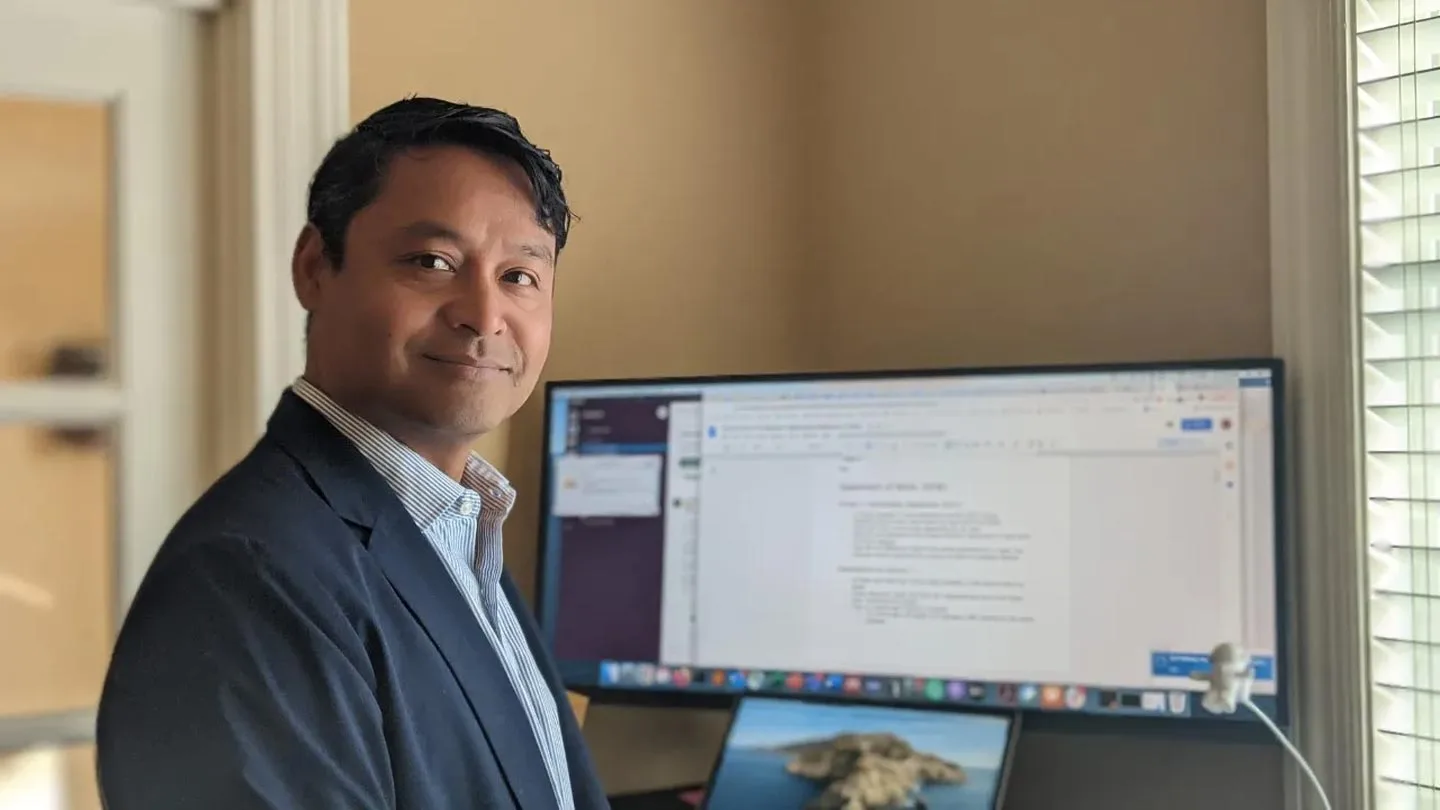
Rahul Ramachandran, who led a NASA Marshall team of more than 100, succeeds John Christy at UAH's Earth System Science Center. He plans to build its AI work.
The University of Alabama in Huntsville has named Rahul Ramachandran director of its Earth System Science Center.
He succeeds John Christy, who led the center from 2000 until his retirement. UAH announced the appointment in a news release on Nov. 13.
Ramachandran is a UAH graduate. He earned his doctorate in atmospheric science at the university in 2002 and spent 15 years on its research staff.
“Returning to UAH feels like coming home,” Ramachandran said in the release.
From NASA Marshall
Ramachandran comes to the center from NASA’s Marshall Space Flight Center in Huntsville. There, he founded and led the Inter-Agency Implementation and Advanced Concepts Team, known as IMPACT. The team is part of NASA’s Earth Science Data Systems program and works to make Earth observation data easier for scientists, federal agencies and decision-makers to use.
Under his leadership, IMPACT grew to more than 100 researchers, engineers and data scientists, UAH said.
His record, as the university listed it:
- helped shape NASA’s artificial intelligence strategy for science
- helped lead the team behind Prithvi, an AI model for Earth observation, which won the American Geophysical Union’s Open Science Award in 2025
- the Presidential Early Career Award for Scientists and Engineers in 2009
- NASA’s Exceptional Achievement Medal in 2018
- the American Geophysical Union’s Leptoukh Lecture in 2023
What he wants the center to do
The Earth System Science Center studies the Earth as a single system. Its work includes climate models, severe weather and storm prediction, lightning, satellite remote sensing, air quality, and water and farm monitoring.
Ramachandran said he wants it to become “a fully AI-augmented research center.” He said AI should support scientists, not replace them.
“My goal is to accelerate trustworthy science, conducted with rigorous evaluation and a clear understanding of AI’s strengths and limitations,” he said.
He also plans to deepen the center’s ties with NASA, particularly Marshall, and to give early-career researchers more responsibility. The university’s AI Foundry sits inside the center’s Quantum AI Hub, which UAH President Donald Leo recently opened, the release said.
What it means for you
The center’s research areas include severe weather, storm prediction, lightning and air quality, the hazards North Alabama lives with. Ramachandran wants UAH researchers involved in NASA work at every stage, from framing the research question to turning the result into a tool people use.
For students and young researchers, he said mentoring early- and mid-career scientists was a significant factor in taking the job. UAH lists the center’s research areas on the Earth System Science Center website.
Have your say